
QUICK ANSWER
Yes—if a second identifier was recorded and cross-referenced before the visual tag was lost. A scanned EID, legible tattoo or individual brand can lead back to the correct ranch number, but only when the operation’s records show that both identifiers belonged to the same animal.
Not every animal needs redundant identification. The strongest case is usually a long-lived or high-consequence animal: a breeding bull, donor or registered female, high-value replacement, or cow whose individual history would be costly to lose. For lower-value or short-term cattle, one well-designed visual system may be entirely reasonable.
A backup is insurance against losing the link
A lost tag is not the same as a lost animal identity. The identity is recoverable when another mark or device leads to the same record. The real failure occurs when the ranch can see the cow but cannot determine which calving, treatment, pedigree or ownership history belongs to her.
Before adding a backup, ask three questions:
-
How long is this animal expected to remain in the herd?
-
What would it cost—in dollars, records or breeding certainty—if her identity became uncertain?
-
Will the crew consistently record and verify the second identifier?
Redundancy has value only when the second method is maintained. Two devices with numbers stored in separate places are not a system; they are two disconnected clues.
Management identification is not always proof of identity
A large visual tag answers the daily question, “Which cow is that?” It helps the crew sort, treat, breed and record cattle quickly. That is management identification.
Proof of identity asks a harder question: “What evidence connects this animal to this specific history?” Confidence may come from a unique physical identifier, the ranch cross-reference, registration records, transfer documents and—in some cases—DNA. No method is self-proving when the mark was recorded incorrectly, applied to the wrong animal or never connected to the record.
An ownership brand may strongly establish source or ownership under applicable state law, but a common ranch brand usually does not distinguish Cow 412 from Cow 413. An EID is unique, but the number must still be attached to the correct record. A registration certificate preserves history, but paper alone cannot point out the animal standing in the pen.
THE RECOVERY TEST
Cover the visual number in your records and imagine the tag is gone. Can someone scan, read or observe a second identifier, search it, and return one—and only one—animal record? If not, the backup is not yet dependable.
How the common methods compare
Each method solves a different part of the problem. Visibility, permanence, cost and certainty do not come in one package.
|
Method |
Best practical use |
Main limitation or added work |
|
Visual ranch tag |
Fast, distant recognition and everyday management |
Can be lost or become unreadable; strongest when another recorded ID points to the same animal |
|
Electronic tag |
Fast scanning, data capture and a unique number |
Needs a reader for efficient use; device and database must be matched; official-device rules may apply |
|
Tattoo |
Permanent, low-profile individual characters for registered or high-value cattle |
Requires restraint and a clean ear to read; poor application, dark pigment or age can reduce legibility |
|
Freeze brand |
Permanent or long-term individual numbers visible at a distance on suitable cattle |
More equipment, time and skill; results vary with coat color, weather, preparation and technique |
|
Hot-iron brand |
Durable ownership or individual identification recognized in many ranching areas |
Causes a permanent hide scar; laws, registration and accepted locations vary by state |
|
Registration record |
Preserves pedigree, ownership and performance history |
Paper or database record does not identify the animal unless it matches a physical identifier |
|
DNA parentage |
Confirms or excludes parents when the animal and candidate parents are properly sampled |
Higher cost and delayed results; does not correct a mislabeled or swapped sample by itself |
Visual ear tags: the everyday working identity
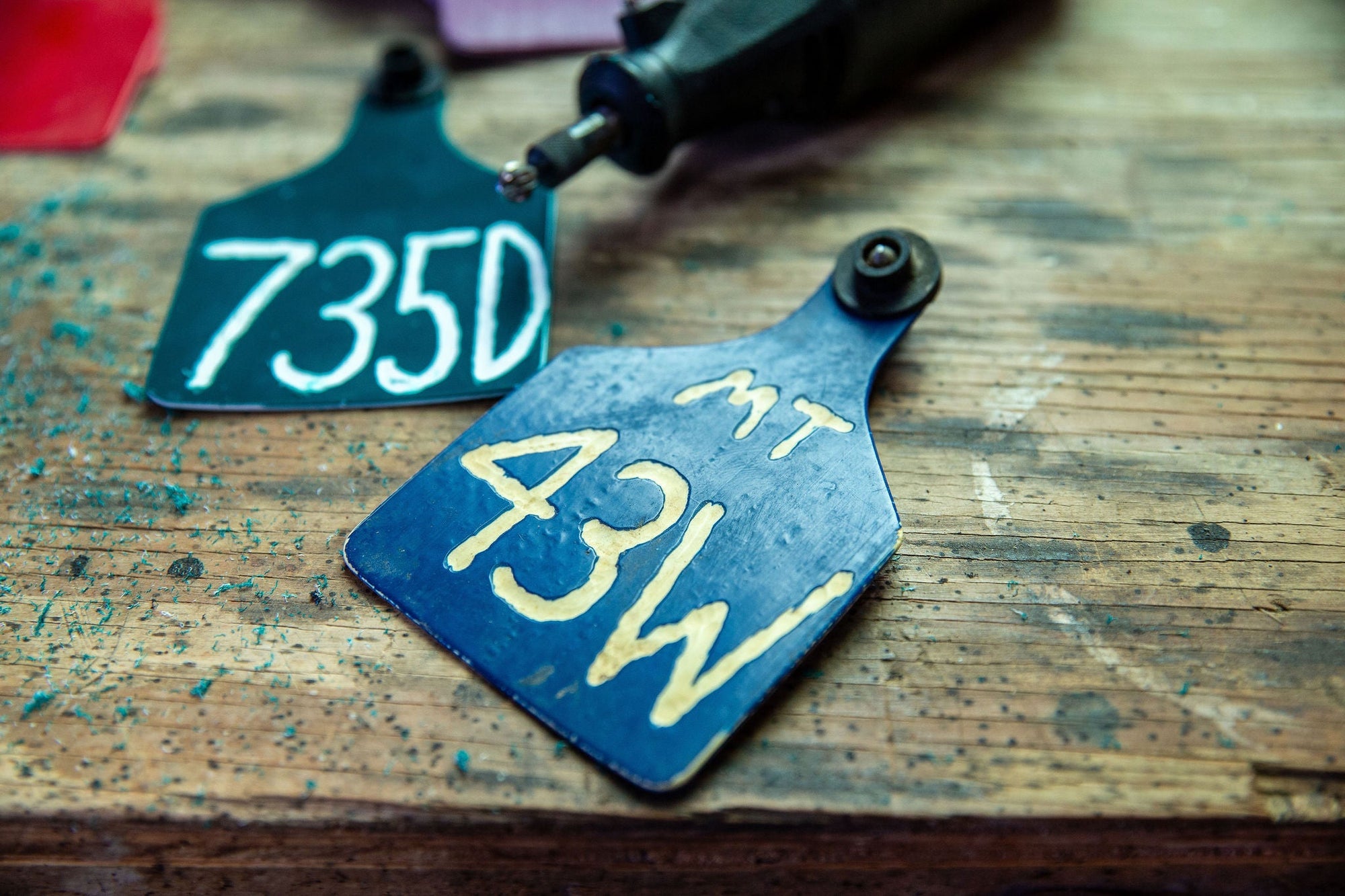
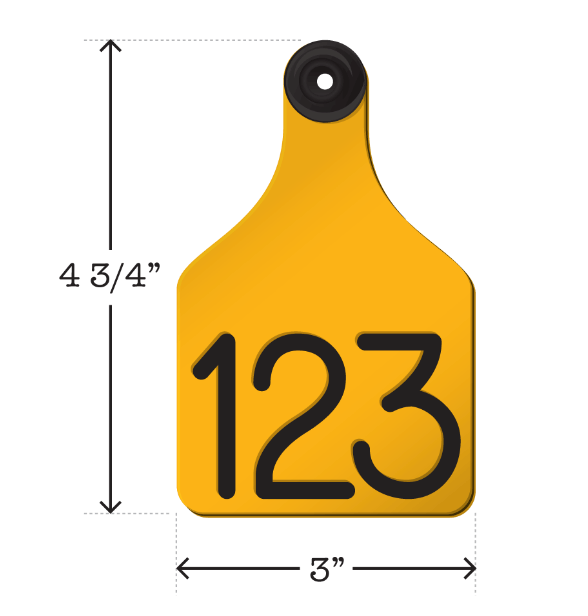
A well-designed visual tag remains the most practical daily identifier for many commercial cow-calf operations. It can be read without a scanner, can carry a short ranch number and can use color or a secondary line to support sorting and recognition.
Its weakness is physical exposure. Tags can snag, tear, separate or become unreadable over time. That makes the visual tag an excellent primary working identity but not always the best only identity for cattle expected to remain in the herd for many years.
If a visual tag is replaced, preserve the old-to-new cross-reference. The replacement tag restores visibility; the cross-reference preserves history.
Electronic tags: unique and efficient, but not visually simple
An electronic identification device carries a unique number that can be captured quickly with a compatible reader. When the EID is connected to the ranch number, a scan can recover the animal’s record after the large visual panel is gone. It can also reduce transcription errors during processing, weighing, breeding or health work.
EID does not automatically replace the ranch tag or the record system. A small button is difficult to read at pasture distance, equipment adds cost, and a scan returns only a number until software or a cross-reference explains what that number means.
Some electronic devices are official identification. Current federal rules restrict removal and replacement of official devices and generally limit the application of multiple official eartags, subject to defined exceptions. Verify current requirements with an accredited veterinarian or State animal-health official. Review current USDA cattle-identification guidance
Tattoos: permanent individual identification that stays out of the way
An ear tattoo can provide a permanent individual number without occupying space needed by a visual or electronic tag. It is common in registered cattle because the tattoo can be recorded on the registration certificate and checked against the animal.
The trade-off is access. The animal normally must be restrained, the ear cleaned and the characters examined in good light. Incomplete ink, poor character placement, darkly pigmented ears, healing problems and changes over time can make a tattoo difficult or impossible to read.
A tattoo works best as a confirmation method, not a pasture-reading method. Record the exact characters and ear at application, and check legibility while the animal is already restrained rather than discovering the problem years later.
Freeze brands: distant individual recognition with more setup
A freeze-branded number can be read from farther away than a tattoo and does not occupy the ear. It can be useful for bulls, donor females, registered cattle, large pastures or operations that want a permanent individual number visible during sorting or heat detection.
Results depend on preparation, timing, equipment, iron temperature, contact and hair color. White-haired cattle require a different endpoint, and poorly applied characters may be incomplete or hard to distinguish. Freeze branding also takes more time, supplies and restraint than installing an ear tag.
Oklahoma State University reports that freeze branding can provide permanent identification, while also noting variability in readability and greater cost and time for small groups. State recognition and brand rules differ, so check the law and brand authority where the cattle are located. See OSU’s freeze-branding guidance
Hot-iron brands: durable ownership identification, with important trade-offs
Hot-iron brands remain an important ownership tool in many Western and Plains states. A properly registered brand and location may support ownership, inspection and recovery of estray or stolen cattle. A separate numeric brand can also identify an individual animal.
A hot brand creates a permanent scar and hide damage, requires correct equipment and restraint, and is subject to state-specific rules about registration, character design and location. The ranch’s ownership brand should not be treated automatically as an individual backup number. It may tell you whose herd the cow came from without telling you which cow she is.
Consult the state brand authority before creating or applying a brand. Brand law is not uniform across the country, and a design used informally may not receive the legal treatment of a properly recorded brand.
Registration records and DNA: valuable evidence, not stand-alone pasture ID
Registration records preserve pedigree, breeder, ownership, performance and physical identification. They become much stronger when the certificate’s tattoo, EID or brand matches the animal. Keep transfers current and preserve old and new ranch numbers as aliases rather than replacing the registered identity.
DNA parentage can confirm or exclude candidate parents when the animal and potential parents have suitable samples on file. This can be valuable for registered cattle, multi-sire breeding groups, donor programs and high-value bulls. It is usually too slow and expensive to serve as routine lost-tag recovery for ordinary commercial cattle.
DNA also depends on sample identity. The American Angus Association cautions that parentage matching cannot account for individual-animal identification errors or sample swaps at the ranch. DNA can test the biology of the submitted sample; it cannot prove that the sample tube was labeled correctly. Read the Angus parentage limitation
Build the backup strategy around the cattle
A sensible system is layered according to risk, not applied identically to every animal.
-
Short-term calves or feeder cattle: A clear visual tag and accurate group or source records may be enough. Add official identification only when movement, program or regulatory requirements call for it.
-
Commercial breeding cows: A durable visual tag may remain primary. A recorded EID, individual tattoo or individual brand can be added when long retention, intensive records or the cost of uncertainty justifies it. A ranch ownership brand alone may not recover the cow number.
-
Breeding bulls: The consequences of losing pedigree, health, fertility or purchase history are higher. Pair an easy-to-read visual number with a permanent or electronic identifier tied to the same record.
-
Registered, donor or high-value cattle: Match the ranch tag to the physical identifier accepted by the breed association—often a tattoo, EID or brand—and keep registration and DNA records current when applicable.
Leave room in the ear for devices the animal may need later, and do not add an official tag merely as a generic backup without understanding the rules. More identifiers can create confusion if the crew cannot tell which number is primary.
RECORD THE PAIR, THEN TEST IT
At application, capture the visual number and backup identifier in the same transaction. Then scan or read the backup and confirm that it opens the correct animal record. Recheck tattoos, brands and devices during normal handling. A backup should be verified before it is needed.
If the visual tag is already gone
Restrain the animal safely and inventory every remaining identifier before applying a replacement. Scan EID, read tattoos, document brands and compare registration, treatment, breeding and pasture records. Use only evidence that points to one animal.
Do not assign the most likely record based on color, age or appearance when more than one animal is possible. Give the animal a temporary number and mark her identity unverified until the evidence is resolved. If an official device is missing, damaged or involved in retagging, contact an accredited veterinarian or State animal-health official before replacing it.
THE BOTTOM LINE
A backup identification method is worthwhile when the cost of losing an animal’s history exceeds the cost and work of maintaining a second reliable identifier. Visual tags provide the best everyday visibility; EID, tattoos and individual brands can add recoverability or permanence; registration records and DNA strengthen the evidence when they are correctly linked.
The goal is not to put every possible identifier on every animal. It is to make sure the cattle that matter most can still be identified with confidence if the primary visual tag is gone. For help building the visual layer of that system, contact Ritchey at 1-800-327-8247 or sales@ritcheytags.com.